High-Density Storage for Labs, Archives and Museums: Lessons from the CSIRO Soil Archive
How high-density drawer storage holds 145,200 samples at CSIRO's National Soil Archive, and what labs, archives and museums can learn from it.
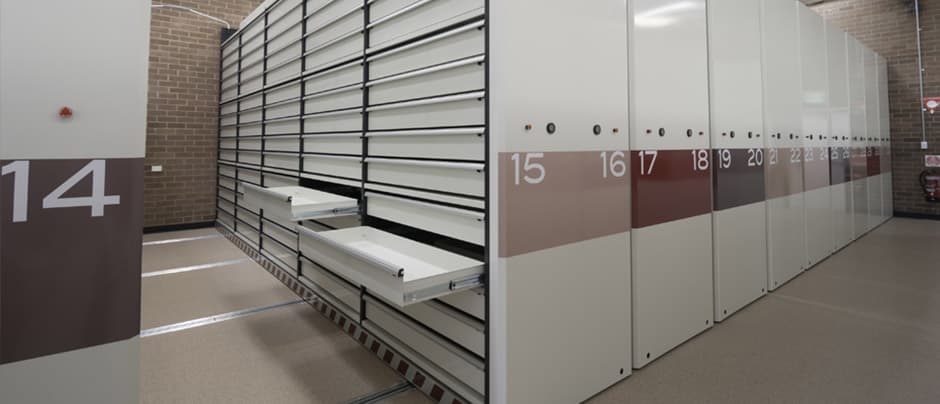
Collections are among the hardest things to store well. They need to be dense, because space is expensive. They need to be accessible, because people use them. And they need to be secure and stable, because they're often irreplaceable. CSIRO's National Soil Archive shows how high-density drawer storage can meet all three. Read the full case study.
The challenge at Black Mountain
The National Soil Archive at Black Mountain in Canberra holds soil samples that have to stay at a stable moisture content for decades. CSIRO tendered for the design, manufacture, installation and commissioning of a rolling storage system for Building 208. The archive needed more capacity without a larger room, and the samples are retrieved regularly, so the storage had to cope with constant use.
The solution
The answer combined two systems:
- A mobile rolling system underneath, compacting the aisles so more storage fits in the same room
- Boscotek high-density drawers holding the sample bottles themselves
The installed system holds 145,200 containers, each about 2kg, in 3,300 drawers, with 44 bottles to a drawer. Numbered bays keep retrieval predictable across more than a hundred thousand containers. (The project was manufactured in Australia by Wilson & Gilkes, before Boscotek joined OPIE Manufacturing Group.)
What made it work
Load rating
With 44 bottles at around 2kg each, every drawer carries close to 90kg of samples. The drawers were specified at 120kg and 200kg UDL, comfortably above the working load.
Cycle life
An archive is opened constantly. The Boscotek drawers were cycle-tested past 150,000 operations, the duty cycle of an archive that's used, not a cupboard that's filled once.
Density and retrieval
Drawers make every item visible and reachable from above, unlike deep shelves where items hide behind each other. Combined with the rolling system's aisle compression, that delivered both density and access.
Lessons for other collections
- Start with the item. Size, weight and handling requirements decide drawer height, partitions and load rating.
- Specify the duty cycle, not just the static load. Ask for test data.
- Plan retrieval. Numbering, labelling and logical grouping matter as much as capacity.
- Design for growth. Adjustable drawer positions let storage change as collections grow. At UQ Archaeology, rails at 25mm centres let labs reconfigure without new cabinets (case study).
- Build in security. Central locking and anti-tilt mechanisms protect valuable items and people.
Beyond soil: other examples
High-density storage works for all sorts of collections:
- University teaching collections. UQ's archaeology labs store human osteology, fossil casts, stone and ceramic artefacts, faunal material and archaeobotanical specimens in Boscotek cabinets specified drawer by drawer, so students can handle collections without leaving them exposed.
- Museums. For the Australian Museum's oversized mammalogy collection, Boscotek built cabinets engineered around large preserved specimens, with full-extension trays for safe handling. See Boscotek for museums.
- Laboratories and health. Consumables, instruments and spare parts all benefit from dense, organised, lockable storage. See laboratories.
Boscotek high-density storage is now manufactured by OPIE Manufacturing Group at Emu Heights, NSW, under a BSI-certified ISO 9001 quality system, with a 5-year warranty.
Frequently asked questions
How do we work out the load rating we need? Multiply the weight of a typical item by the number per drawer, then add a margin. At CSIRO, 44 bottles at about 2kg each came to roughly 90kg, comfortably within 120kg and 200kg ratings.
Can drawers be reconfigured as collections change? Yes. Drawer positions can be adjusted, and partitions changed, so storage can follow the collection rather than forcing a new purchase.
Is high-density storage suitable for heavy or oversized items? Yes, with the right engineering. The Australian Museum's mammalogy cabinets were designed around large specimens, with full-extension trays for safe handling.
Can cabinets be locked? Central locking systems secure every drawer in a cabinet. That was a key requirement for UQ's student-accessible collections.
Planning collection storage? Contact our team or explore high-density cupboards.
