Tool Control in Defence and Aviation Workshops: A Practical Guide
Tool control reduces FOD risk and lost time in defence and aviation workshops. A practical guide to visual tool storage and the right cabinets.

In aviation and defence maintenance, a missing tool isn't just an inconvenience. A spanner left in an engine bay or a fastener lost on a hangar floor can become foreign object debris (FOD), with serious safety and cost consequences. Good tool control is one of the simplest and most effective ways to manage that risk, and it starts with storage.
Why tool control matters
Effective tool control helps workshops to:
Prevent FOD by confirming every tool is accounted for before an aircraft or vehicle is released
Save time otherwise spent searching for tools
Reduce loss and replacement costs
Support audits with clear, demonstrable processes
Improve safety by keeping tools off floors and benches
The principles of visual tool storage
Visual tool storage (VTS) means every tool has a defined, visible home, so a missing tool is obvious at a glance. The key principles:
One place for each tool. Drawers are partitioned or fitted with inserts so each item sits in a specific position.
Visibility. Full-extension drawers let users see every position, right to the back.
Kitting. Tools are grouped by task or by technician, so a kit can be checked out and in.
Security. Locks control access to calibrated or controlled tools.
Proximity. Tools are stored where the work happens.
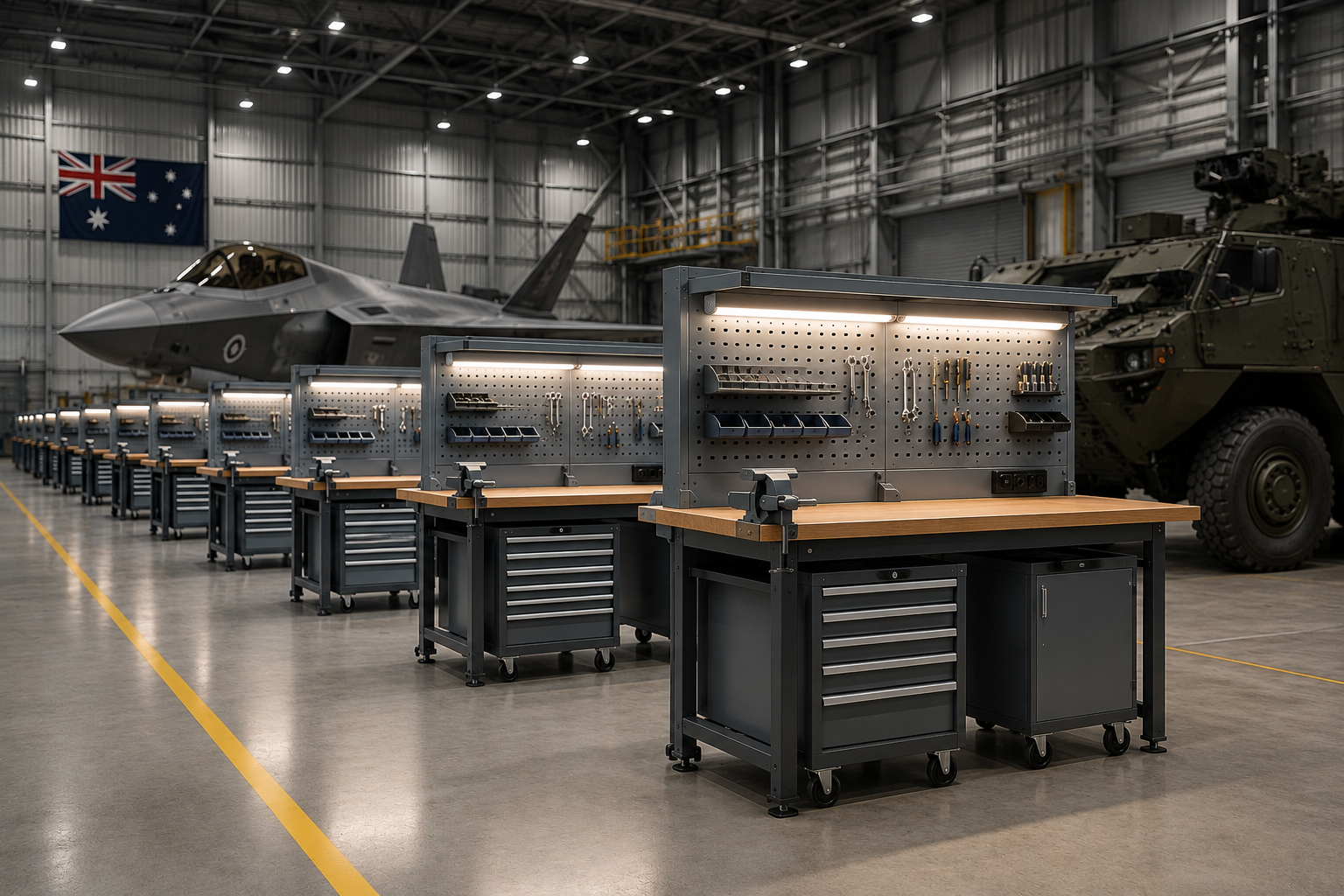
Choosing storage for tool control
High-density drawer cabinets
Boscotek high-density cabinets are the backbone of many tool control systems. Drawers can be configured with partitions to suit each tool kit. Full-extension drawers rated around 150–200kg (depending on width) keep heavy tools accessible, and anti-tilt interlocks allow only one drawer open at a time. Cabinets come in S Series (605mm deep) and D Series (755mm deep) to suit different spaces.
Mobile storage at the point of work
Mobile tool carts and line-feed trolleys bring tools to the aircraft or vehicle. Our mobile tool cart is rated to 400kg, and linefeed trolleys to 400kg or 800kg depending on length. HeliMods, a Queensland helicopter engineering business, used Boscotek line-feed trolleys to keep tools and parts at the airframe rather than in a distant store (case study).
Flight Line cabinets
The Boscotek Flight Line cabinet was originally developed for aviation. It's mobile and double-sided, with clear polycarbonate roller shutters, so contents are visible at a glance and protected from dust. Wintec used mobile Flight Line cabinets for precision tools in its trades facility (case study). Learn more on our aviation page.
Implementing a tool control system
Audit the tools. List every tool needed for each type of task.
Design the kits. Group tools by task, shift or technician.
Configure the storage. Use the Boscotek configurator to plan cabinets and drawers, or talk to us about custom layouts.
Label and mark. Label drawers and positions, and mark tools to their home location.
Set the process. Define check-out, check-in and end-of-shift checks.
Review. Audit regularly and adjust as tools and tasks change.
Common mistakes
Over-filling drawers, so items stack and hide each other
Generic storage that doesn't match the tools
Central stores far from the work, which encourage people to keep tools at their station
No process, because storage alone doesn't create control
Built for demanding environments
Boscotek is Defence Approved , and supports defence, aviation and transport workshops with storage designed as a system. It's manufactured by OPIE Manufacturing Group in Western Sydney under an ISO-certified quality system and backed by a 5-year warranty.
Frequently asked questions
Do we need foam inserts for tool control? Not always. Partitions and labelled positions work well for many kits. Foam inserts are useful where tool shapes vary or visual checks need to be very fast.
Should every technician have their own cabinet? It depends on the work. Personal kits suit specialised roles, and shared, task-based kits suit standardised work. Many workshops use a mix.
Can storage be secured for calibrated tools? Yes. Lockable cabinets with central locking help control access to calibrated or controlled tooling.
How do we get started? Pick one bay or one team and pilot a tool control setup for a month. Measure search time and missing-tool incidents before and after, then roll it out.
Planning a tool control upgrade? Contact our team to discuss your workshop.
